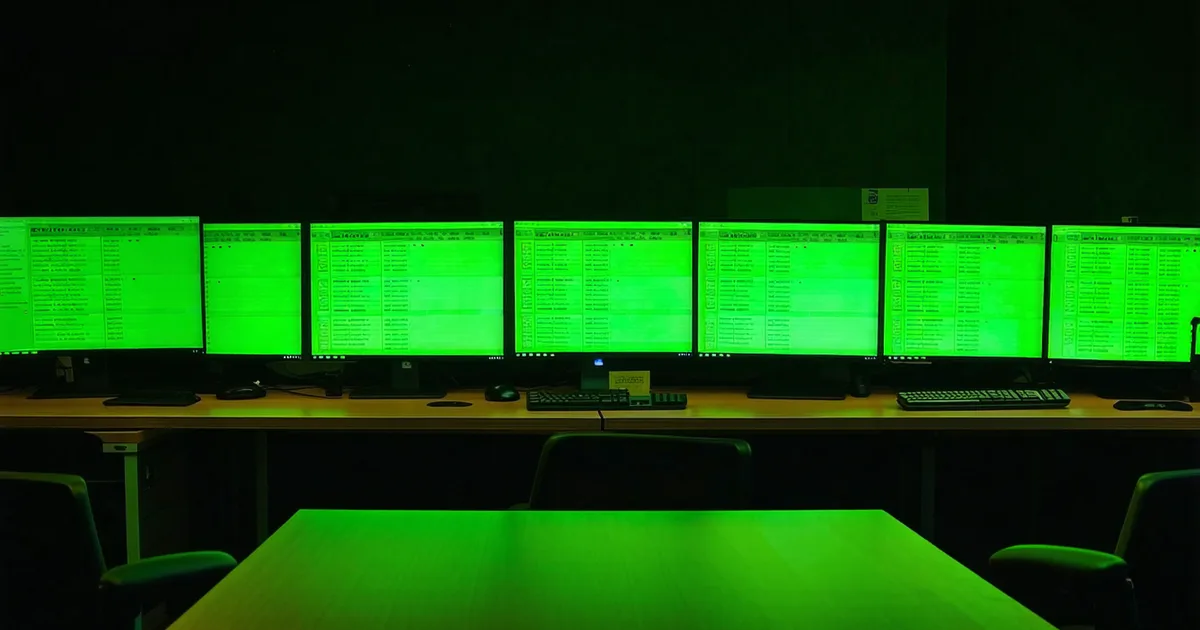
Before we built anything, I spent about eight months working directly inside a mid-size SaaS company's support operations as a consultant. The company had grown fast — from a 20-person team to 40 people over 18 months — and they brought me in because CSAT had started slipping even as headcount climbed. The problem they described was "we need to get faster." The real problem, once I got inside the queue, was something different.
Almost every morning, the team opened a queue with several hundred new tickets. And almost every morning, roughly 65-70% of those tickets were variations on the same ten questions. Password reset. Billing discrepancy. "Where is my export?" Status of a pending item. Change notification address. The agents knew the answers cold — they could close these tickets in 90 seconds each. But they still had to open each one, read it, type a response, and close it. Multiply that by 200 tickets and you've consumed most of a workday across five agents before anyone touches anything that actually requires judgment.
The second thing I noticed: the new hires hired to "solve" the volume problem were spending their first four to six weeks doing almost nothing but those 90-second tickets. Not because they were assigned to them — because those tickets were just always there, always urgent by SLA, always the first thing to grab. The institutional knowledge they needed to handle complex escalations was sitting in the brains of the three senior agents, who were too busy supervising new hires to document anything. The team was running in a perfectly self-reinforcing trap.
What triage actually costs
If you run a support team right now, you probably have a gut feel for what triage costs. But the number that hit me hardest was not the time — it was the cognitive switching cost. Every time a skilled agent breaks flow to handle a password reset, they are not just spending 90 seconds on that ticket. They are spending another two minutes getting back into the context of the harder thing they were doing before. Across a day of constant context switching, you are losing an hour per agent in recovered attention time alone.
The companies I talked to when we started building Replixa described this in similar terms. Not "we have too many tickets" — more like "we have the wrong tickets in front of the wrong people all the time." The queue was not sorted. It was first-in, first-out with manual re-prioritization that never really happened because the team was too busy working tickets to re-prioritize them.
Triage tools existed — most helpdesk platforms have auto-assignment and some form of intent tagging — but they routed tickets, they did not resolve them. Routing a password reset to the right agent queue is still a human opening that ticket and typing a password reset link. The routing problem was solved. The resolution problem was not.
The deflection mirage
When we started talking to other founders and heads of support about what they had tried, "AI chatbot" came up constantly. And the experience was consistent: they had deployed a chatbot, it deflected some tickets by pointing users at help articles, but CSAT either stayed flat or fell. The reason was simple and we have written more about it elsewhere: deflection is not resolution. When a customer with a real account problem gets pointed at an article, they close the chat, wait ten minutes, and submit a ticket anyway. The ticket volume did not change. The deflection metric looked good. The customer did not get their problem solved.
We are not saying chatbots and self-service tools have no value — they absolutely do for some question types, especially pure-discovery questions where the user just needs information. But for anything involving the user's specific account state, a transaction, a setting, or a permission, an article link is not a resolution. We built Replixa on the premise that the only honest measure of automated support is whether the customer's problem was actually closed — not whether they were redirected.
The technical constraint that shaped our architecture
The reason most automation stops at deflection is a technical one, not a philosophical one. Resolving a ticket — as opposed to deflecting it — requires read and sometimes write access to the customer's actual data. To close a billing discrepancy, you need to pull the customer's invoice history and potentially issue a credit. To answer "where is my export," you need to query the job status from the backend. To reset a password, you need to call the identity provider's API.
Deflection tools are read-only by design because integrating real data access is hard to get right. One wrong API call against the wrong account is a serious incident. So the safe path is to stay in read-only territory and call it "AI support."
We decided early that Replixa's architecture had to include first-class integration with the data systems that support agents actually use — not just the helpdesk layer on top of them. That meant building an integration framework that could connect to billing systems, product backends, identity providers, and CRMs with scoped, auditable API access. We wanted every resolution action that Replixa takes to be logged, attributable, and reversible where possible. That is what makes real resolution safe at scale rather than dangerous.
Why we stayed bootstrapped
One choice we made early that shaped everything: we did not raise external capital. This was deliberate. When you raise a seed round, the implicit pressure is to optimize for growth metrics fast — ticket volume handled, number of integrations, number of logos. We did not want to run that playbook. We wanted to stay focused on resolution quality, which means taking on customers slowly, understanding their support topology deeply before deploying, and being honest when a use case is not right for Replixa yet.
Staying bootstrapped also meant we could build at the pace of quality rather than the pace of pressure. The first twelve months of building Replixa were almost entirely infrastructure — the integration layer, the confidence scoring system, the escalation logic that keeps humans in the loop for anything the model is not certain about. We did not launch a customer-facing product until we could demonstrate 85%+ resolution accuracy on a controlled dataset. That kind of patience is only possible when you are not burning through a runway that someone else owns.
What we got wrong first
We initially thought the right architecture was a single large model doing intent classification and resolution together. It was slow and expensive to operate, and accuracy on edge cases was unpredictable in ways that were hard to debug. The insight that fixed this was separating the classification pass from the resolution pass. A faster, cheaper classification step categorizes the ticket and assigns a confidence score before the resolution model ever sees it. Low-confidence tickets bypass the model entirely and go directly to human agents with the classification metadata attached, so the agent has context even without AI involvement.
This two-pass architecture is now the core of how Replixa works, and it is what makes the escalation logic reliable. The system is never trying to resolve something it is not confident about. That single structural choice is what closes the gap between "AI chatbot that occasionally gets things wrong" and "resolution system that agents actually trust."
Where we are now
Replixa today can connect to your helpdesk platform, read new tickets as they arrive, classify intent with a confidence score, resolve the ones it is certain about, and escalate the rest with structured metadata. We support Zendesk and Intercom as primary helpdesk surfaces, with more integrations in active development.
The team that built this is five people, including the three of us who co-founded it. We work out of Austin and we talk to every customer directly before they go live. We are not going to be the right fit for every support team, and we will tell you that clearly. But if your queue is 60-70% repetitive resolvable tickets and your best agents are burning out closing password resets, this is exactly what we built for.
The support triage trap is not a people problem. It is a structural problem that gets worse as you hire. We built Replixa because the only fix is getting the resolvable work out of the human queue entirely — not routing it better, but closing it autonomously before a human ever touches it.