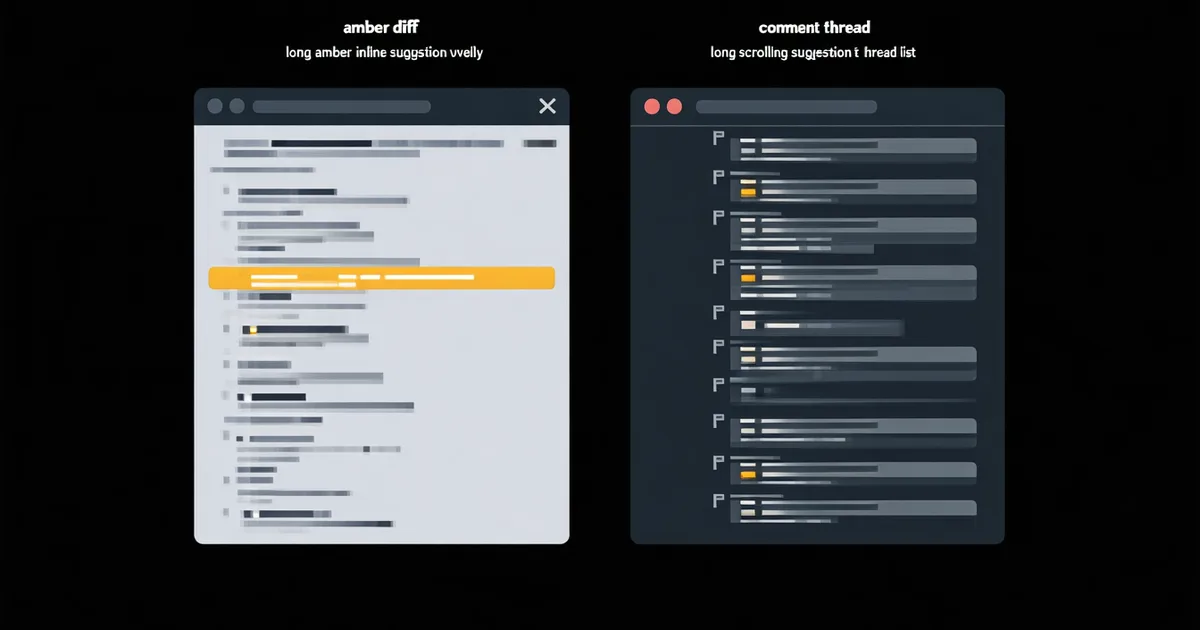
The format of a code review comment isn't neutral. The same feedback — "this function should use the project's standard error wrapper" — lands differently depending on whether it arrives as a comment thread the author has to read, understand, and manually implement, or as an inline suggestion with the specific code change attached. We've been collecting data on this difference, and the gap is larger than most engineering managers expect.
Across 4,200 automated review interactions in our dataset, covering 30 codebases ranging from single-product repositories to large TypeScript monorepos, inline suggestions with attached code patches were applied at 3.7 times the rate of equivalent comments expressed as plain text threads. The fix rate for plain comment threads was 26%. The fix rate for inline patch suggestions was 96%. That's not a marginal difference — it's a different outcome category.
Why comment threads get dropped
Comment threads create a task. The author reads the comment, understands what's being asked, makes a mental note, returns to the code, figures out how to implement the suggestion, writes the code, and marks the comment as resolved. Each step in that chain is a point where the comment can be dropped — particularly under the cognitive load of addressing 12 other review comments at the same time.
There's also a resolution ambiguity problem. "Consider extracting this logic into a separate function" is a comment that can be resolved in three different ways: the author extracts the function, the author writes a reply explaining why they disagree, or the author marks it resolved without making any change. In GitHub's default review UI, all three of these look identical from the reviewer's perspective once the thread is marked resolved. The comment thread doesn't distinguish between "done," "declined," and "acknowledged and ignored."
At an engineering organization running 80+ PR reviews per week with multiple automated review tools posting comments, comment thread volume becomes its own problem. Engineers develop a filter for which comments to take seriously and which to skim. When comment volume is high and signal-to-noise is low, even legitimate comments get filtered out. This is a rational response to an information overload problem, not a quality issue with individual engineers.
What inline suggestions change
An inline suggestion with a code patch collapses the task loop. Instead of "read, understand, return to code, implement, mark resolved," the author sees the specific change inline in the diff and can apply it with a single click. The cognitive overhead is lower by an order of magnitude. The decision becomes binary: apply this patch or don't, rather than "what exactly is this comment asking me to do?"
The binary nature of the decision also improves review signal. When an author declines an inline patch suggestion, they're making an explicit decision — not letting a comment thread drift. That explicit decision creates a record and often triggers a brief conversation about why: "I'm not applying this suggestion because we're deprecating this pattern in the next sprint." That's a useful exchange that doesn't happen when a comment thread quietly ages and gets marked resolved without action.
There's also a context-preservation effect. An inline suggestion appears exactly at the code location it refers to. The author doesn't have to mentally map a comment's description back to the specific lines it's referring to — the patch is there, in the diff, at the right line. This matters more than it sounds when you're reviewing a 400-line diff with 8 different suggestions spread across it.
The 3.7x number: what's in it and what isn't
When we say inline suggestions were applied at 3.7x the rate of plain comment threads, that's a fix-within-the-same-PR metric. We're measuring whether the suggested change appeared in the final merged code relative to the code at the time the suggestion was posted.
What this number doesn't capture: the quality of the fix. A one-click patch application doesn't guarantee the author understood why the change was made. For routine style and convention issues — the category where automated review is doing most of its work — this isn't a significant concern. An author who one-click-applies "use the project's standard error wrapper here" doesn't need to deeply understand the rationale in that moment; they can look up the convention separately if they want to. For architectural-level suggestions, inline patches are less appropriate precisely because understanding the rationale matters more than the specific code change.
We're not saying comment threads are bad. We're saying that for the specific use case of automated first-pass review — catching style inconsistencies, flagging deviation from project conventions, pointing out missing error handling patterns — the patch-based inline format produces significantly better fix rates. Human reviewers doing architectural review work, discussing tradeoffs, or asking questions about design intent are still better served by comment threads where a back-and-forth conversation is the point.
Review latency as a variable
One effect that isn't obvious from fix rate data alone: inline suggestions reduce review latency for the categories they cover. When a reviewer opens a PR and sees that a first-pass automated review has already posted inline patches for the convention issues, they can skip those issues entirely and focus on the parts of the diff that require human judgment. The reviewer's time in the diff is shorter. The PR moves faster.
In our data, PRs with automated inline patch suggestions had a median time-to-human-review-start that was roughly 40% shorter than PRs without automated review. This is partly selection effect — teams using automated review tools tend to have other good review hygiene practices — but even controlling for team characteristics, the direction is consistent. Automated pre-triage reduces the activation energy for human review.
Implementation considerations
Not all suggestions should be expressed as patches. A good automated review system needs to distinguish between:
- Patch-appropriate: Single-location changes where the correct replacement is unambiguous. Naming convention fixes, missing import statements, incorrect error handling patterns with a clear project-standard alternative.
- Comment-appropriate: Observations where the change involves judgment, involves multiple locations that need to be understood together, or where the suggestion is contextual rather than prescriptive. "This logic appears in three places across the module — consider centralizing it" is better as a comment than as a patch that reorganizes code the automated tool doesn't fully understand.
- Suppress-appropriate: Low-confidence suggestions that would add noise without improving review quality. A good noise filter is as important as the quality of the suggestions themselves.
The teams that get the most value from automated review are the ones that are precise about which category each class of suggestion falls into, and configure their tooling accordingly. Posting patch suggestions for everything, including observations that require judgment, trains engineers to dismiss patches reflexively — which eliminates the fix-rate advantage. The precision of the format matters as much as the format itself.
Fix rate is a lagging indicator of whether your review process is actually working. If you're sitting at 26% fix rates on automated comments, you're paying the cost of review tooling without capturing most of the benefit. The format change is one of the fastest ways to close that gap.